TL;DR:
- Native plants and xeriscaping are water-efficient and suitable for Lubbock's climate.
- Traditional turf requires high water, mowing, and fertilization, making it less sustainable locally.
- Community programs like Adopt-A-Tree support drought-tolerant landscaping and neighborhood involvement.
Caring for public spaces in Lubbock is not as simple as planting grass and watering it. Between the clay soils, relentless summer heat, and drought-prone conditions that define life on the South Plains, even the toughest lawns can struggle. But here's the good news: Lubbock homeowners have real opportunities to transform medians, parks, and shared community areas into spaces that are beautiful, water-smart, and genuinely inviting. This article walks you through the criteria for choosing the right approach, the best practical ideas, a side-by-side comparison of methods, and tailored recommendations for different community spaces.
Table of Contents
- Criteria for choosing public space lawn care strategies in Lubbock
- Top lawn care ideas for Lubbock public spaces
- Comparing lawn care methods: Traditional turf vs. innovative approaches
- Situational recommendations: Matching lawn care ideas to Lubbock community needs
- A fresh perspective: Why Lubbock homeowners should rethink public space lawns
- Connect with Lubbock's lawn care experts
- Frequently asked questions
Key Takeaways
| Point | Details |
|---|---|
| Prioritize native plants | Native species reduce water use and make public spaces in Lubbock more resilient. |
| Deep infrequent watering | Water lawns deeply every 2-4 weeks to encourage healthy root systems and conserve water. |
| Community programs matter | City-led projects like Adopt-A-Tree engage residents and improve Lubbock’s public spaces. |
| Consider xeriscaping | Xeriscaping is a low-maintenance, eco-friendly option ideal for Lubbock’s climate. |
| Compare lawn methods | Innovative approaches offer lower costs and higher community value than traditional turf. |
Criteria for choosing public space lawn care strategies in Lubbock
Before you pick a plant or turn on a sprinkler, it helps to think through what actually makes a public space lawn care strategy work in Lubbock. Not every approach that thrives in Dallas or Austin will survive here. The criteria below give you a solid framework to evaluate your options.
Key factors to assess:
- Climate and soil compatibility. Lubbock sits in a semi-arid zone with alkaline, clay-heavy soils. Any strategy you choose needs to handle low rainfall, high winds, and temperature swings between seasons.
- Water efficiency. Water management programs are essential in Texas due to limited resources and varied soil types. Look for approaches that use drip irrigation, rain barrels, or drought-tolerant species.
- Maintenance load. Public spaces often rely on volunteers or limited city crews. Lower-maintenance options reduce long-term costs and keep spaces looking good without constant attention.
- Community engagement potential. The best public lawn strategies invite neighbors to participate, whether through planting days, adopt-a-tree programs, or neighborhood clean-up events.
- Local regulations. Lubbock has water restriction schedules and city ordinances that govern what you can plant and how often you can water in shared spaces. Always check before you start.
- Aesthetics and curb appeal. A beautiful space draws people in. Color, texture, and seasonal interest matter, especially for medians and park entrances that make a first impression.
Pro Tip: Before committing to a lawn care strategy for a shared public space, visit the area at different times of day. Morning shade, afternoon sun exposure, and foot traffic patterns all affect which plants and grasses will actually thrive.
When you balance these criteria together, the right strategy becomes much clearer. Exploring eco-friendly lawn care tips can help you narrow down options that fit Lubbock's conditions without sacrificing visual appeal. If your space needs a full reset first, restoring Lubbock lawns from the ground up is often the smartest starting point before introducing new plantings.
Top lawn care ideas for Lubbock public spaces
With criteria clarified, explore practical care ideas you can bring to Lubbock's public spaces. These approaches are grounded in what actually works in West Texas, not just what looks good in a gardening magazine.
Native plant installations. Plants like buffalo grass, blue grama, black-eyed Susan, and Texas sage are built for this climate. They need minimal water once established and attract pollinators, which adds biodiversity to the space. Native plants and xeriscaping significantly reduce water use and attract community engagement, as proven by Lubbock's own Mesquite Mile project.
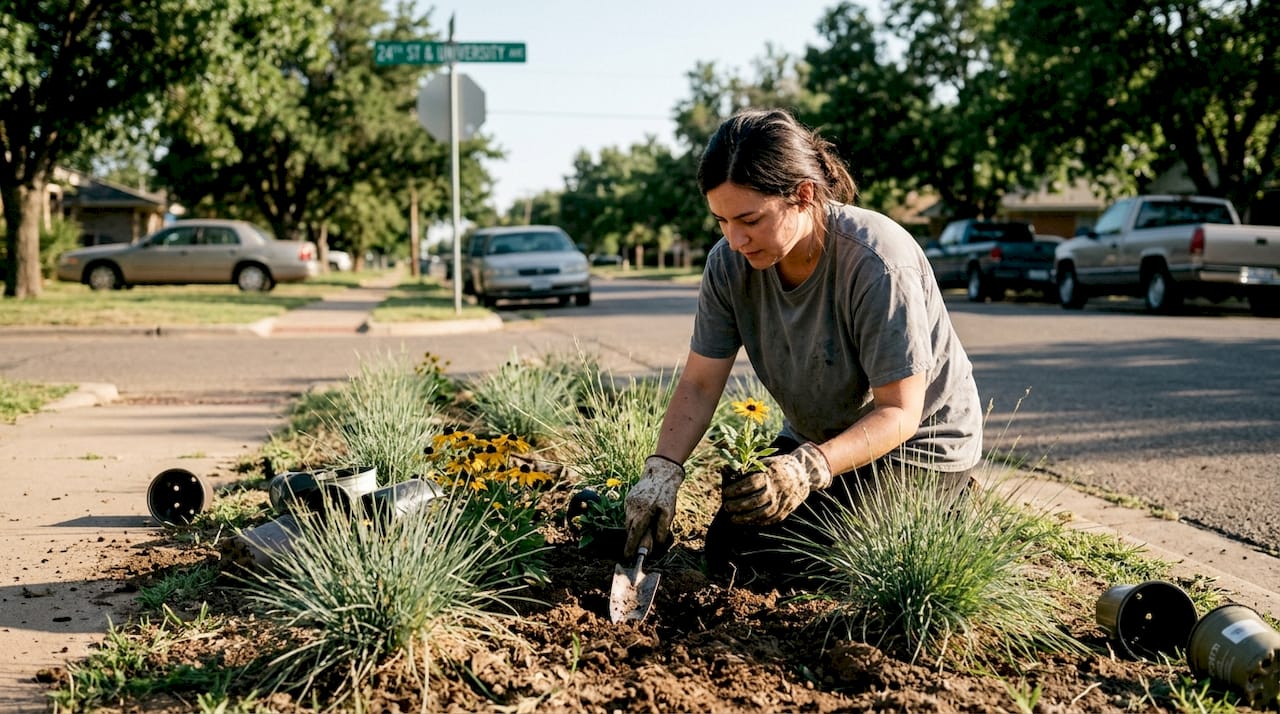
Xeriscaping with decorative rock and mulch. Replace thirsty turf sections with gravel paths, decomposed granite, and drought-tolerant shrubs. This cuts irrigation needs dramatically while keeping the space clean and organized.
Rain barrel and stormwater systems. Curb cuts that direct runoff into planted areas, combined with simple rain barrels, help capture and reuse water that would otherwise be lost. This is especially effective in medians and park edges.
Community tree planting events. Trees provide shade, reduce urban heat, and give neighbors a reason to gather. Lubbock's Adopt-A-Tree program makes this easy and structured.
Practical steps to get started:
- Survey the public space and note soil type, drainage, and sun exposure.
- Contact the City of Lubbock Parks and Recreation department to confirm any permits or program opportunities.
- Choose two or three native species suited to the specific spot.
- Organize a community planting day to build neighborhood investment.
- Set up a simple watering schedule using drip irrigation or soaker hoses.
"The Mesquite Mile showed that local plants can solve real flooding problems while making Lubbock look great. That's the kind of community win every neighborhood should aim for."
Pro Tip: Start small. Pick one median or corner lot, nail the native plant mix, then expand. A visible success story is the best recruiting tool for getting more neighbors involved.
For a broader look at how these ideas apply to shared spaces, the guide on public property landscaping basics covers the planning side in detail. You can also use the Lubbock lawn care checklist to keep your seasonal tasks on track.
Comparing lawn care methods: Traditional turf vs. innovative approaches
With ideas explored, compare their impact and practicality for Lubbock public spaces. This side-by-side look helps you see exactly where each method wins and where it falls short.
| Feature | Traditional turf (Bermuda) | Native plants and xeriscaping |
|---|---|---|
| Water use | High (1+ inch per week) | Low (minimal once established) |
| Mowing frequency | Weekly during growing season | Rarely or never |
| Fertilization needs | High, multiple times per year | Low to none |
| Upfront cost | Moderate | Moderate to high |
| Long-term cost | High (water, labor, inputs) | Low |
| Biodiversity | Low | High |
| Community appeal | Familiar, traditional look | Modern, natural, conversation-starting |
| Drought resilience | Poor without irrigation | Excellent |
Warm-season grasses like Bermuda and native plants have very different water, mowing, and fertilization demands. Traditional turf consistently requires higher inputs across the board.
Where traditional turf still makes sense:
- High-traffic athletic fields where a firm, even surface is needed
- Areas where city codes require maintained grass
- Spaces with reliable irrigation infrastructure already in place
Where innovative approaches win:
- Medians and roadsides with no irrigation hookups
- Community gardens and naturalized park edges
- Any space where volunteer maintenance is the primary option
Understanding the importance of lawn maintenance helps you see why cutting inputs in public spaces is not laziness but smart planning. If you do keep traditional turf in some areas, a proper lawn aeration guide will help you get the most out of it in Lubbock's compacted clay soils.
Situational recommendations: Matching lawn care ideas to Lubbock community needs
Finally, match these lawn care ideas to real community situations and needs. Every public space is different, and the right strategy depends on who uses it, how it's maintained, and what the neighborhood values.
| Space type | Best approach | Key species or method |
|---|---|---|
| Street medians | Xeriscaping with native grasses | Buffalo grass, blue grama, rock mulch |
| Neighborhood parks | Native plant mix with shade trees | Texas sage, live oak, black-eyed Susan |
| Communal green areas | Low-mow turf with native borders | Bermuda core with native edge planting |
| School grounds | Drought-tolerant turf and trees | Bermuda with Adopt-A-Tree species |
| Stormwater areas | Rain gardens with native perennials | Inland sea oats, switchgrass |
Recommended action plan for homeowners:
- Identify which type of public space is near your home and which category above fits best.
- Reach out to neighbors or your HOA to gauge interest in a shared project.
- Apply for the City of Lubbock's Adopt-A-Tree program. The program recommends watering young trees with PVC pipes and choosing drought-resistant varieties for long-term survival.
- Follow seasonal timing. Spring planting gives native species the best chance to establish before summer heat peaks.
- Track your results and share them with neighbors to build momentum.
Pro Tip: When fertilizing in shared spaces, less is almost always more. Over-fertilizing native plants can actually weaken them. Stick to a light application of slow-release fertilizer in early spring and let the plants do the rest.
For timing your efforts well, spring lawn care tips are a great resource. If you do need to feed traditional turf areas, lawn fertilizing tips and a clear look at lawn fertilization benefits will help you apply the right products at the right time.
A fresh perspective: Why Lubbock homeowners should rethink public space lawns
Most homeowners default to traditional turf for public spaces because it's familiar. But familiar is not always right for Lubbock. We've seen firsthand that neighborhoods clinging to high-water turf in medians and parks are spending more money, doing more work, and getting worse results than neighbors who made the switch to native-focused designs.
The uncomfortable truth is that a perfectly manicured Bermuda median looks great for about six weeks in spring. After that, it's a constant battle against heat, drought, and compaction. Native plants, by contrast, often look their best in the same conditions that destroy traditional turf.
Low-maintenance natives and xeriscaping offer practical, ecological, and social advantages that turf simply cannot match in this climate. Projects like the Mesquite Mile prove that community-driven native landscaping creates lasting pride, not just a pretty yard. Exploring eco-friendly lawn care options is not a trend. For Lubbock, it's the practical choice.
Connect with Lubbock's lawn care experts
Ready to take what you've learned and put it into action? Whether you're sprucing up a shared median or organizing a neighborhood planting event, having the right support makes all the difference.
Only Mow is Lubbock's trusted lawn care partner and the official vendor for the City of Lubbock. We offer Lubbock lawn care services for both residential and public spaces, from routine mowing to full landscape transformations. If you're a contractor looking to grow your business in the area, explore opportunities with Lubbock landscaping contractors or take the first step and sign up as a contractor today. Lubbock's public spaces deserve professional care, and we're here to help make that happen.
Frequently asked questions
What are the best public space lawn care ideas for drought-prone Lubbock areas?
Native plants, xeriscaping, and programs like Adopt-A-Tree help conserve water and enhance community engagement. Water-saving techniques like drip irrigation and rain barrels make these approaches even more effective in Lubbock's dry climate.
How often should public lawns in Lubbock be watered?
Public lawns should be watered deeply and infrequently, typically 1 inch every 2 to 4 weeks depending on conditions. Deep infrequent watering encourages deeper root growth and better drought tolerance over time.
What community programs support public space lawn care in Lubbock?
The City Parks Adopt-A-Tree program encourages community care for young, drought-tolerant trees, and the Lubbock Memorial Arboretum offers a great place to learn about locally adapted species.
Are traditional turf lawns effective for public spaces in Lubbock?
Traditional turf works in high-traffic areas but demands far more water and maintenance than most public spaces can sustain. Warm-season grasses and native plants differ significantly in their input needs, and natives are better suited to Lubbock's climate long term.