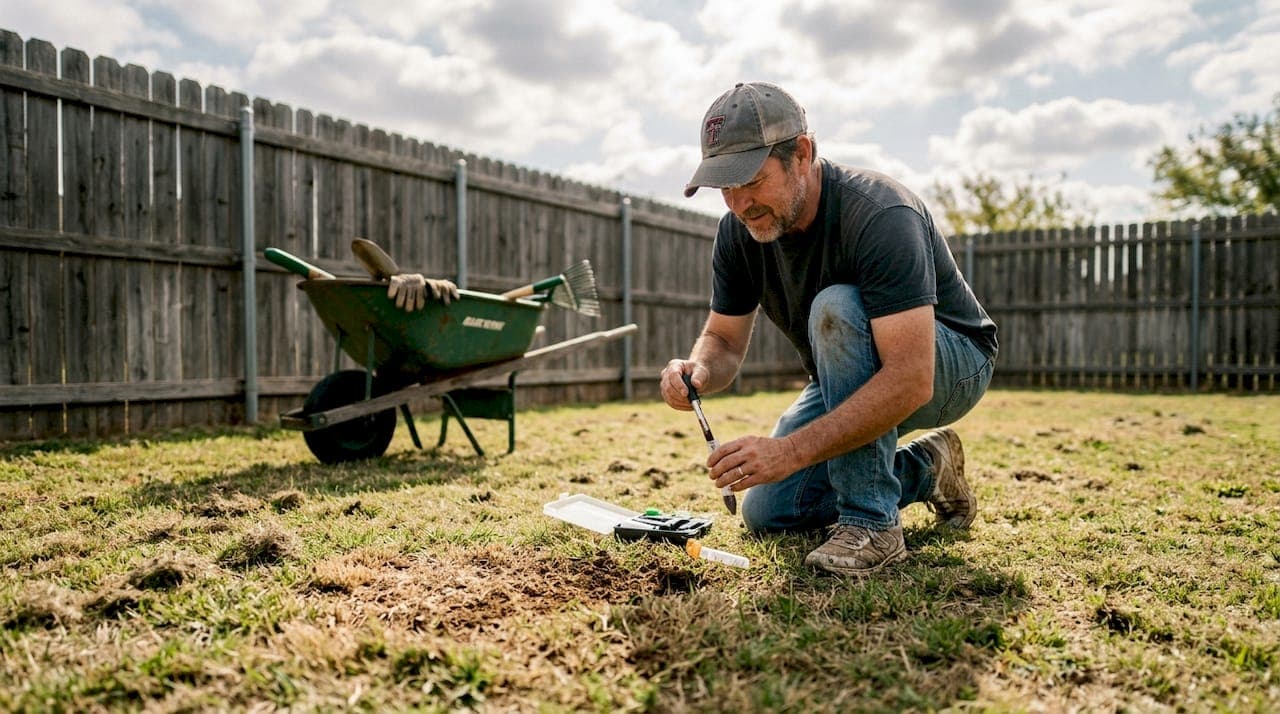
Choosing the right fertilizer for your Lubbock lawn can feel overwhelming when you face alkaline soils, scorching summers, and unpredictable rainfall. Many homeowners apply too much nitrogen at the wrong time, leading to burned grass or weak growth that invites weeds. This guide delivers proven, research-backed fertilizing strategies tailored specifically for Lubbock's climate and soil conditions. You'll learn how to test your soil, select the best fertilizer type, time applications correctly, and avoid common mistakes that waste money and harm your yard. By following these practical tips, you can transform your lawn into a lush, healthy landscape that thrives year-round.
Table of Contents
- Understanding your lawn's fertilizing needs: soil tests and basics
- Selecting and applying the right fertilizer for Lubbock lawns
- Adjusting fertilizing practices for Lubbock's climate challenges
- Comparing fertilizing options and common pitfalls in Lubbock
- Enhance your Lubbock lawn with professional care
- Frequently asked questions about lawn fertilizing in Lubbock
Key takeaways
| Point | Details |
|---|---|
| Soil testing first | Test every 2-3 years to identify nutrient gaps and pH levels before applying any fertilizer. |
| Right nitrogen rates | Bermuda grass needs 2-5 pounds of nitrogen per 1,000 square feet annually, split into 3-4 applications. |
| Slow-release formulas | Use slow-release fertilizers to minimize burn risk and provide steady nutrient delivery. |
| Climate adjustments | Reduce nitrogen during droughts and avoid fertilizing in peak summer heat to protect lawn health. |
| Proper application | Calibrate your spreader and water within 24 hours to ensure even coverage and prevent damage. |
Understanding your lawn's fertilizing needs: soil tests and basics
Before you spread a single granule of fertilizer, you need to know what your soil actually needs. Conducting a soil test identifies nutrient deficiencies and pH levels, giving you a roadmap for effective fertilizing. Lubbock soils tend to be alkaline with high calcium carbonate content, which can lock up nutrients like iron and phosphorus even when they're present.
The ideal soil pH for most lawn grasses in Lubbock falls between 6.0 and 7.0. Within this range, essential nutrients remain available for grass roots to absorb. When pH climbs above 7.5, common in our area, micronutrients become chemically bound and unavailable. Testing reveals these hidden problems before you waste money on fertilizers your lawn can't use.
Avoid the temptation to apply fertilizer without testing. Overfertilizing is a common error that leads to lawn burn, excessive growth requiring more mowing, and aggressive weed invasion. The Texas A&M AgriLife Extension office in Lubbock provides reliable local soil testing services with customized recommendations for our region. Their experts understand the unique challenges of West Texas soils and can guide you toward the right products and application rates.
Pro Tip: Test your soil every 2-3 years and always after major landscape changes like adding topsoil or installing new irrigation. Keep records of your results to track trends over time.
Here's what you should request in a basic soil test:
- pH level and lime requirement
- Nitrogen, phosphorus, and potassium levels
- Organic matter percentage
- Salinity and sodium levels
- Micronutrient status for iron and zinc
For homeowners seeking professional guidance on soil testing for Lubbock lawns, local services can collect samples and interpret results to create a customized fertilizing plan.
Selecting and applying the right fertilizer for Lubbock lawns
Once you understand your soil's needs, choosing the right fertilizer becomes straightforward. Slow-release nitrogen fertilizers with a 4-6:1:1 N-P-K ratio work well when you don't have soil test results. These formulas provide steady nutrient delivery over weeks rather than flooding your grass with a quick burst that increases burn risk.

Bermuda grass, the most common lawn species in Lubbock, has specific nitrogen requirements based on how intensively you maintain your yard. Annual nitrogen benchmarks range from 2 pounds per 1,000 square feet for low-maintenance lawns to 4-5 pounds for high-maintenance landscapes. Split these totals into 3-4 separate applications spaced 4-8 weeks apart during the growing season from spring through early fall.
| Maintenance Level | Annual Nitrogen (lb/1000 sq ft) | Applications per Year | Timing |
|---|---|---|---|
| Low maintenance | 2 | 2-3 | April, July |
| Moderate maintenance | 2-3 | 3 | April, June, August |
| High maintenance | 4-5 | 4 | April, June, July, September |
Timing matters as much as the product you choose. Apply fertilizer in the morning when dew helps granules stick to soil rather than bounce off grass blades. Water your lawn within 24 hours after application to move nutrients into the root zone and prevent surface burn. Missing this watering step is one of the fastest ways to damage your turf.
Follow this step-by-step procedure for even, effective fertilizer application:
- Mow your lawn 1-2 days before fertilizing to ensure granules reach the soil surface
- Calibrate your spreader according to the fertilizer bag instructions for your specific model
- Apply half the recommended amount in one direction across your lawn
- Apply the remaining half in a perpendicular direction to ensure complete coverage
- Water thoroughly within 24 hours, applying at least 0.25 inches to move nutrients down
- Keep pets and children off treated areas until after the first watering
Pro Tip: Mark your spreader settings directly on the fertilizer bag with a permanent marker. This saves time during your next application and ensures consistency across seasons.
For homeowners planning their annual lawn care calendar, these spring fertilizing tips for Lubbock lawns provide detailed guidance on kickstarting growth after winter dormancy.
Adjusting fertilizing practices for Lubbock's climate challenges
Lubbock's climate throws curveballs that require you to adapt your fertilizing strategy throughout the year. Our hot, dry summers and unpredictable rainfall patterns mean standard fertilizing schedules often need modification. Moderate nitrogen application during drought maintains lawn quality better than either high rates or skipping fertilizer entirely.
When water becomes scarce, your grass enters survival mode. Deep, infrequent watering becomes critical to maintain fertilizer benefits and reduce heat stress. Apply 1 inch of water per week in a single session rather than multiple shallow waterings. This encourages roots to grow deeper, making your lawn more drought-tolerant over time.
Special situations require tailored approaches. New sod installations need phosphorus-rich starter fertilizer applied before laying sod and again 4-6 weeks after installation. Phosphorus promotes rapid root development, helping new grass establish quickly. Sandy soils common in parts of Lubbock leach nutrients faster than clay soils, requiring more frequent light applications rather than heavy seasonal doses.
| Soil Type | Fertilizing Frequency | Nitrogen per Application | Special Considerations |
|---|---|---|---|
| Sandy loam | Every 4-6 weeks | 0.5-0.75 lb/1000 sq ft | Increase frequency, reduce amount |
| Clay loam | Every 6-8 weeks | 0.75-1.0 lb/1000 sq ft | Standard schedule works well |
| Calcareous clay | Every 6-8 weeks | 0.75-1.0 lb/1000 sq ft | Aerate before fertilizing |
Avoid fertilizing during peak summer heat in July and August when temperatures regularly exceed 95°F. Your grass is already stressed, and adding nitrogen forces new growth that the plant can't support. This combination invites disease, increases water demand, and often results in brown patches.
Pro Tip: Aerate compacted calcareous soils common in Lubbock before your spring fertilizer application. This breaks through the hardpan layer and allows nutrients to reach root zones more effectively.
"In water-deficit conditions, maintaining moderate nitrogen fertility preserves turf quality and color better than either eliminating fertilizer or applying high rates. The key is matching inputs to the grass's reduced capacity for growth during stress periods." – Texas A&M Turfgrass Research
Homeowners who invest in lawn aeration benefits in Lubbock see improved fertilizer efficiency because nutrients penetrate deeper into compacted soil profiles.
Comparing fertilizing options and common pitfalls in Lubbock
Understanding the trade-offs between fertilizer types helps you make informed decisions for your specific lawn goals. Synthetic quick-release fertilizers deliver nitrogen rapidly, producing visible greening within days. However, this speed comes with higher burn risk if you apply too much or forget to water immediately. Organic slow-release options provide gentler, sustained feeding but cost more per pound of actual nitrogen.
| Fertilizer Type | Pros | Cons | Best For |
|---|---|---|---|
| Synthetic quick-release | Fast results, lower cost, precise N-P-K ratios | Higher burn risk, requires careful watering, short-lived | High-maintenance lawns, spring greenup |
| Organic slow-release | Lower burn risk, improves soil biology, gradual feeding | More expensive, slower visible results, variable nutrient content | Low-maintenance lawns, summer applications |
| Synthetic slow-release | Balanced performance, predictable release, moderate cost | Still requires watering, some burn risk at high rates | Most Lubbock lawns, general use |
Your grass species matters more than many homeowners realize. High nitrogen rates support lush Bermuda grass but prove completely wrong for Buffalograss lawns that thrive on minimal inputs. Buffalograss needs only 1-2 pounds of nitrogen annually, and excess fertilizer encourages weed competition while reducing the grass's natural drought tolerance.
Avoid these five common fertilizing mistakes that plague Lubbock lawns:
- Applying fertilizer to drought-stressed grass without adequate irrigation
- Using the same rate year-round instead of adjusting for seasonal growth patterns
- Skipping spreader calibration and guessing application rates
- Fertilizing immediately before or after herbicide treatments
- Ignoring soil test results and applying unnecessary phosphorus
Overfertilizing ranks as the most frequent and damaging error. Excess nitrogen promotes rapid leaf growth at the expense of root development, making your lawn dependent on constant inputs. You'll also see increased thatch buildup, greater disease susceptibility, and aggressive weed germination. The money you save by applying only what your soil test recommends far exceeds the cost of the test itself.
Pro Tip: Choose your fertilizer type based on your lawn species and maintenance goals, not just price. A slightly more expensive slow-release product often delivers better results with less risk than the cheapest quick-release option.
Homeowners looking to avoid costly errors can review this comprehensive guide on Lubbock lawn care mistakes to avoid for additional tips on maintaining healthy turf year-round.
Enhance your Lubbock lawn with professional care
You now have the knowledge to fertilize your lawn effectively, but implementing these practices consistently takes time and equipment many homeowners don't have. Only Mow offers expert fertilizing and comprehensive lawn care services designed specifically for Lubbock's unique soil and climate challenges. Their local team understands exactly when to apply nutrients, how to adjust for our alkaline soils, and which products work best for West Texas conditions.

Professional service ensures correct fertilizer application rates and timing without the guesswork or risk of damaging your lawn. Only Mow's Lubbock lawn care and mowing services include soil-appropriate fertilizing programs, proper spreader calibration, and post-application watering guidance. Whether you need a one-time treatment or ongoing seasonal maintenance, their experienced crew delivers consistent results that transform struggling lawns into healthy, vibrant landscapes. As the official vendor for the City of Lubbock, they bring proven expertise and local credibility to every project. Explore their local landscaping services in Lubbock or consider joining their team by learning how to become a Lubbock lawn care contractor.
Frequently asked questions about lawn fertilizing in Lubbock
How often should I fertilize my Bermuda lawn in Lubbock?
Apply fertilizer 3-4 times from spring through early fall, spacing applications 4-8 weeks apart during active growth periods. Adjust frequency based on your maintenance goals and soil test results, with low-maintenance lawns needing only 2 applications while high-maintenance landscapes benefit from 4 seasonal treatments.
Is soil testing really necessary before fertilizing?
Soil testing determines nutrient needs and optimal pH to avoid over-application and lawn damage. Testing is especially valuable in Lubbock due to our alkaline soils and high calcium carbonate content, which affect nutrient availability differently than in other regions. The small investment in testing saves money by preventing unnecessary fertilizer purchases.
What are signs of overfertilizing my lawn?
Yellowing or browning leaf tips, excessive top growth with weak roots, increased weed germination, and white salt crusting on soil surfaces all indicate overfertilizing. You might also notice rapid growth requiring frequent mowing, greater disease susceptibility, and brown patches where fertilizer concentrated. Reduce application rates and increase watering to flush excess salts if you observe these symptoms.
Can I fertilize during Lubbock's hot summer months?
Avoid fertilizing in peak summer heat to prevent burn and protect lawn health during stress periods. Focus your fertilizing schedule on spring and early fall when temperatures moderate and grass actively grows. If you must fertilize in summer, use half the normal rate and water immediately to minimize stress.
Should I use organic or synthetic fertilizer in Lubbock?
Organic slow-release fertilizers reduce burn risk and improve soil health gradually, while synthetic options deliver faster visible results but require more careful application. Choose based on your priorities: organics work well for low-maintenance lawns and summer applications, while synthetics excel for spring greenup and high-maintenance landscapes. Many homeowners find success with synthetic slow-release formulas that balance performance and safety.