TL;DR:
- Most property managers in Lubbock overlook the value of native plants and smart irrigation for cost savings. Implementing climate-appropriate landscaping increases property value and reduces long-term maintenance costs. Consistent, standards-based upkeep and understanding local regulations are crucial for maximizing landscape performance.
Most property managers in Lubbock think public space landscaping means keeping the grass cut and the hedges trimmed. That view leaves serious money on the table. A well-designed landscape strategy can increase nearby property values by up to 96% and cut long-term maintenance costs by 30% or more. This guide walks you through the core principles, Lubbock-specific regulations, proven maintenance methods, and the real business case for investing in smarter public landscapes. Whether you manage a commercial property, a community park, or a city-adjacent strip, what follows will change how you think about every square foot of outdoor space.
Table of Contents
- Understanding the fundamentals of public property landscaping
- Best practices for Lubbock's semi-arid climate and city codes
- Maintenance methodologies: Keeping public spaces thriving
- Managing edge cases and complex public landscape scenarios
- The business and community impact of smart landscaping
- Why most Lubbock properties miss out on the true value of smart landscaping
- Partnering for landscaping success in Lubbock
- Frequently asked questions
Key Takeaways
| Point | Details |
|---|---|
| Native plants save money | Choosing native species can cut maintenance costs by up to 70% while improving public space appearance. |
| Compliance is crucial | Following Lubbock codes, including tree bans and brush clearance, ensures legal operations and public safety. |
| Routine maintenance drives results | Weekly mowing, seasonal pruning, and regular inspections keep landscapes healthy and inviting year-round. |
| Smart design boosts value | Sustainable landscaping can raise nearby property values by nearly 100% and reduce operational costs long term. |
Understanding the fundamentals of public property landscaping
Public property landscaping is not just about appearances. It is a system. Every plant, irrigation line, and soil amendment either works with your budget or against it. Getting the foundation right means fewer emergency fixes, lower water bills, and spaces that actually hold up under heavy use.
The core mechanics of civic landscaping include native plant selection, water-efficient irrigation, mulching for moisture retention and weed suppression, soil amendment with organic content, and stormwater management through rain gardens and permeable surfaces. These are not optional upgrades. They are the building blocks of any landscape that performs reliably over time.
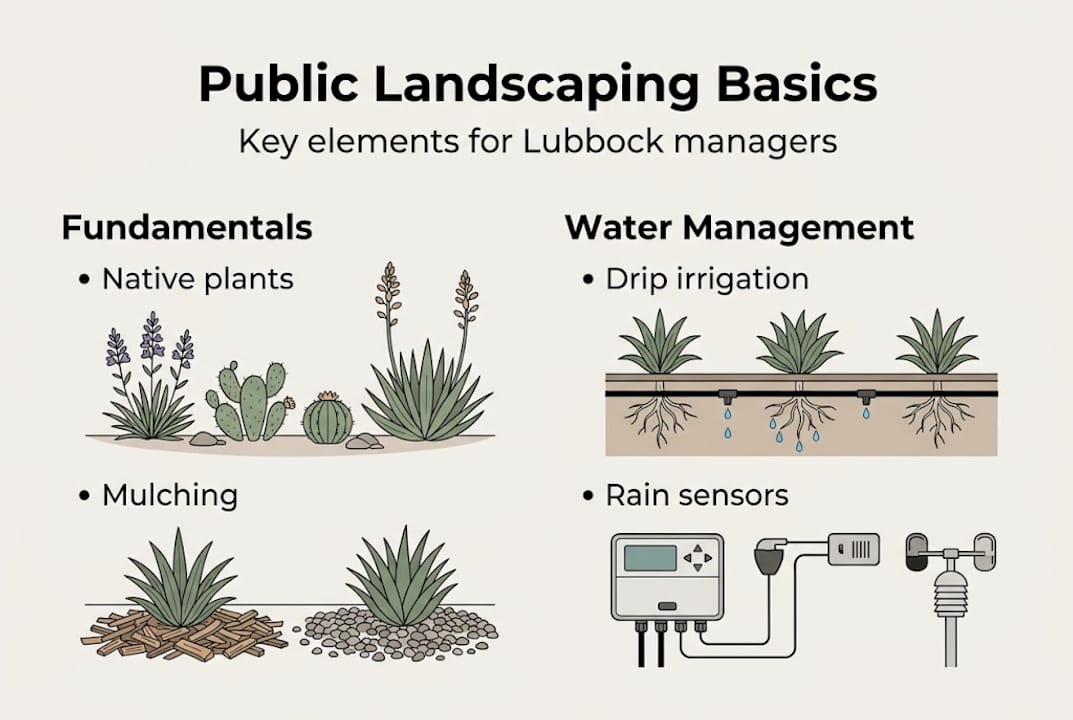
One of the biggest myths is that native plants are boring or hard to source. In reality, they are the smartest financial choice available. Native plants cut maintenance costs by 50 to 70% compared to non-native species that need constant watering, fertilizing, and pest control. Xeriscaping, which is the practice of designing landscapes to minimize water use, pairs perfectly with native plantings in a semi-arid environment like Lubbock.
Here are the core elements every public landscape plan should address:
- Plant selection: Choose species adapted to local soil and rainfall patterns
- Irrigation efficiency: Use drip systems or smart controllers to reduce waste
- Mulching: Apply 2 to 3 inches to retain moisture and suppress weeds
- Soil health: Amend with compost to improve drainage and nutrient content
- Stormwater control: Use rain gardens or permeable pavers to manage runoff
For a deeper look at what ongoing care looks like, the landscape maintenance guide covers the full scope of tasks involved. You can also explore eco-friendly lawn care tips for practical approaches that work in this region.
Pro Tip: Spending more upfront on native plantings and quality irrigation infrastructure typically pays back within two to three growing seasons through reduced water and labor costs.
With the basics in mind, let's deepen the discussion by focusing on best practices proven for Lubbock's climate and standards.
Best practices for Lubbock's semi-arid climate and city codes
Lubbock sits in a semi-arid zone where summer temperatures regularly exceed 100 degrees and annual rainfall averages around 18 inches. That combination punishes landscapes designed for wetter climates. What works in Dallas or Houston will fail here without serious adaptation.
Following Lubbock's tree and brush regulations is not optional. The city prohibits specific tree species from street plantings, including poplar, maple, willow, cottonwood, sycamore, and ash. These trees are either too water-hungry, structurally weak in high winds, or prone to disease in this climate. Compliance protects you legally and prevents costly removals down the road.
Here is a step-by-step approach for setting up a code-compliant, climate-smart public landscape in Lubbock:
- Review city ordinances before selecting any plant material or starting any ground disturbance
- Call 811 before any digging. Utility locate requirements apply to all landscaping work near public rights-of-way
- Select drought-tolerant species such as Texas sage, buffalo grass, desert willow, and live oak
- Plan irrigation zones around plant water needs, not convenience
- Confirm ADA clearance on all pathways, ensuring 60-inch minimum width and firm, stable surfaces
- Schedule brush clearance at least once per season to maintain fire safety compliance
Statistic: Brush must be cleared within 30 feet of all structures under Lubbock fire safety rules. Failing to maintain this buffer creates both legal liability and genuine fire risk.
The seasonal landscaping guide breaks down what tasks to prioritize in each quarter of the year, which is especially useful when managing multiple properties across different microclimates within the city.
Pro Tip: Deep, infrequent watering trains roots to grow downward, making plants far more drought-resistant than frequent shallow watering. Aim for one to two deep waterings per week during peak heat rather than daily light cycles.
Understanding both the fundamentals and local requirements, let's look closer at how to maintain these landscapes for ongoing performance and safety.
Maintenance methodologies: Keeping public spaces thriving
A well-designed landscape still fails without consistent maintenance. The goal is not just keeping things tidy. It is preserving function, safety, and visual appeal across every season.

Weekly mowing during the growing season, ANSI-certified pruning practices, and Integrated Pest Management (IPM) preferences together ensure both safety and long-term aesthetics. IPM prioritizes cultural and mechanical controls over chemical treatments, which reduces costs and environmental impact over time.
Common maintenance cycle tasks include:
- Mowing at a minimum height of 4 inches to protect root systems
- Pruning dead or hazardous limbs using ANSI A300 standards
- Inspecting irrigation systems monthly for leaks, clogs, or coverage gaps
- Applying pre-emergent weed control in early spring and fall
- Refreshing mulch layers annually to maintain 2 to 3 inch depth
- Conducting seasonal plant health assessments for pest or disease signs
Pruning to ANSI A300 standards and conducting regular inspections keep public spaces safe and legally compliant. This matters especially near walkways, parking areas, and high-traffic zones where a fallen limb or overgrown shrub creates liability.
| Task | Frequency |
|---|---|
| Mowing | Weekly (growing season) |
| Irrigation checks | Monthly |
| Mulch refresh | Annually |
| Pruning | Seasonally or as needed |
| Pest/weed control | Bi-annually (spring and fall) |
| Full site inspection | Quarterly |
"Consistent, standards-based maintenance is what separates a public space that builds community pride from one that becomes a liability."
Well-maintained public landscapes also boost property value for surrounding parcels, which is a metric that matters to both city planners and private property managers.
After covering maintenance practices, it's crucial to examine common challenges and how to navigate tricky scenarios unique to public property.
Managing edge cases and complex public landscape scenarios
Not every public space fits a standard template. Parkway strips, high-security zones, and drought-prone areas all come with their own rules and tradeoffs.
Parkway strips, sometimes called hellstrips, are the narrow bands of land between the sidewalk and the street. These areas require permits, low-growing plants with at least 50% ground coverage, and strict utility clearance compliance. They are also one of the most visible parts of any public streetscape, so getting them right pays off in curb appeal.
For high-traffic or security-sensitive areas, plant selection shifts toward durability and visibility. Dense shrubs near building entrances can create concealment risks. Official setback guidelines recommend small trees at least 4 feet from the curb, medium and large trees at least 6 feet out, and a minimum 10-foot clearance from overhead wires.
Compliance checkpoints to review before any public landscape project:
- Confirm permit requirements for the specific zone or right-of-way
- Verify utility locates are complete before any ground disturbance
- Check plant height restrictions for sightline and safety compliance
- Review ADA requirements for all pedestrian paths and access points
- Confirm brush clearance distances from structures and property lines
| Approach | Water use | Maintenance cost | Drought resilience |
|---|---|---|---|
| Turfgrass | High | High | Low |
| Native xeric plants | Low | Low | High |
The contrast is stark. For Lubbock's climate, native xeric approaches are not just environmentally responsible. They are financially superior. Explore the full range of types of landscaping services available locally, and consider how streamlining landscape workflows can reduce administrative burden across multiple sites.
Equipped with practical tools and understanding of special cases, let's zoom out and see how these basics drive real-world business and civic impact.
The business and community impact of smart landscaping
The numbers behind smart public landscaping are hard to ignore. Sustainable landscape design can increase nearby property values by up to 96% and cut construction and maintenance costs by 5 to 30%. Parks and well-designed public spaces also drive measurable increases in visitor counts and reduce water consumption significantly.
For property managers, this translates directly to competitive advantage. A well-maintained public space raises the perceived value of every adjacent property. Tenants pay more. Visitors stay longer. Local businesses see more foot traffic.
"One municipal park redesign using native plantings and smart irrigation reduced annual water use by 40% while increasing community event attendance by 60% in the first two years."
The ROI case for investing beyond minimum compliance is strong. When you track metrics like water savings, visitor counts, and adjacent property value trends, you build a data-driven argument for budget increases and grant funding. Cities and foundations regularly fund projects that demonstrate measurable environmental and community outcomes.
For landlords and commercial managers, mowing tips for curb appeal offer a practical starting point for improving visual impact without major capital investment.
Let's wrap up with a Lubbock-focused perspective: what smart landscaping really means for modern managers and how it reshapes business strategy.
Why most Lubbock properties miss out on the true value of smart landscaping
Here is the uncomfortable truth: most property managers in Lubbock are leaving real value behind by treating landscaping as a line item to minimize rather than an asset to develop. The mow-and-go approach keeps spaces looking acceptable. It does not build community pride, attract tenants, or generate the kind of return that smart design delivers.
The properties that outperform their neighbors share one habit. They track outcomes. Water saved per season. Visitor counts before and after a redesign. Maintenance hours reduced by switching to native plants. These numbers do not just justify the investment internally. They open doors to grants, city partnerships, and vendor negotiations that basic compliance never will.
Conventional wisdom says spend as little as possible on public green space. Top performers know the opposite is true. A modest increase in landscape investment, focused on the right plants, the right systems, and consistent standards-based care, compounds over time in ways that are genuinely measurable. Streamlining your landscaping workflow is the first step toward managing that investment efficiently across multiple sites.
Pro Tip: Start tracking two or three landscape performance metrics this season. Water use, maintenance hours, and tenant satisfaction scores are easy to measure and powerful to present.
Partnering for landscaping success in Lubbock
Knowing what best-practice public landscaping looks like is one thing. Executing it consistently across multiple properties, through Lubbock's heat, wind, and regulatory landscape, is another challenge entirely.
Only Mow is the official vendor for the City of Lubbock, which means we understand local codes, climate realities, and what it takes to keep public spaces performing at a high level year-round. From permit-compliant parkway strip work to full seasonal maintenance programs, we handle the details so you can focus on managing your properties. If you are ready to move beyond basic upkeep and start building landscapes that deliver real returns, connect with Lubbock's landscaping experts today. Contractors and service partners can also get started through our contractor sign up page.
Frequently asked questions
What is the most cost-effective landscaping approach for public property in Lubbock?
Using native, drought-tolerant plants combined with smart irrigation is the most cost-effective strategy, cutting maintenance costs by 50 to 70% and reducing water use significantly compared to conventional plantings.
Are there any prohibited plants or trees for Lubbock street landscaping?
Yes. Prohibited street trees in Lubbock include poplar, maple, willow, cottonwood, sycamore, and ash due to their poor performance in the local climate and structural risks.
How does public landscaping impact nearby property values?
Quality public landscaping can increase property values by 38 to 96% near resilient, well-designed parks and green spaces.
What maintenance standards should public spaces in Lubbock follow?
Public spaces should follow ANSI A300 pruning standards, mow at a minimum height of 4 inches, use IPM pest control methods, and maintain a 30-foot brush-free zone around all structures.
Do I need special permits for landscaping parkway strips in Lubbock?
Yes. Parkway strip projects require permits and must comply with height restrictions, minimum 50% ground coverage rules, and utility locate requirements before any work begins.