TL;DR:
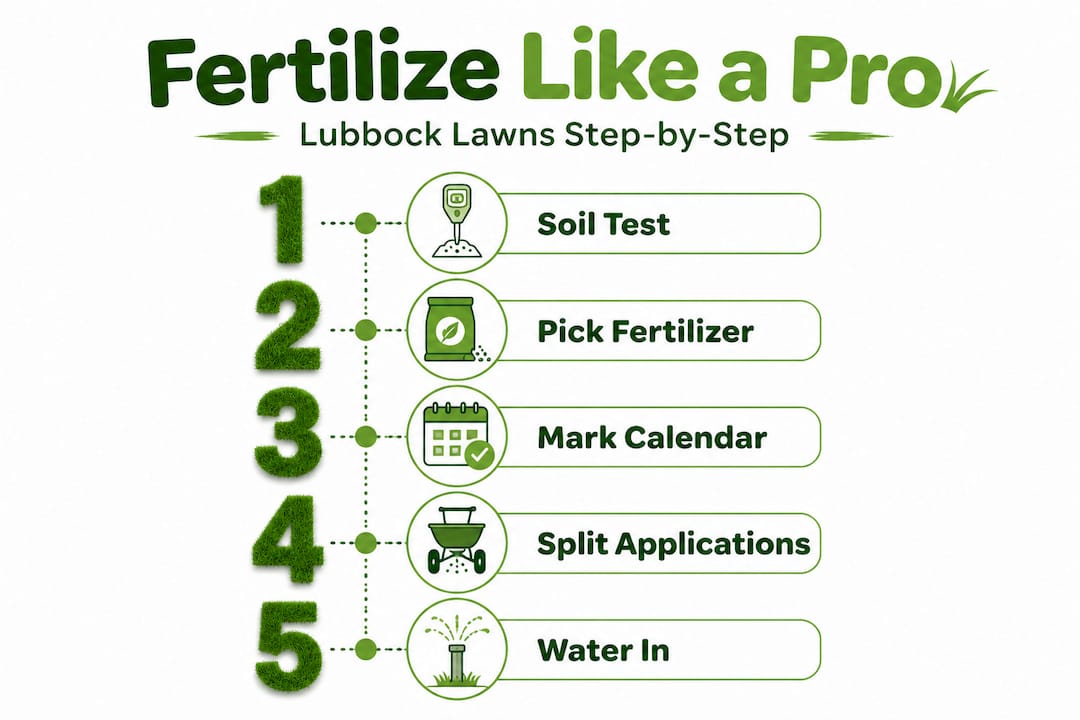
- Proper fertilization requires soil testing to identify specific nutrient needs in Lubbock's alkaline soils.
- Split applications and correct timing help prevent lawn damage and environmental runoff.
- Following science-based guidelines ensures healthier lawns and protects local water ecosystems.
Patchy grass, yellowing turf, and bags of fertilizer that seem to do nothing — sound familiar? Most Lubbock homeowners aren't failing because they lack effort. They're failing because fertilization without a plan is little more than expensive guesswork. Lubbock's alkaline soils, intense summer heat, and unpredictable moisture levels create unique challenges that generic bag instructions simply don't account for. This guide gives you a clear, research-backed roadmap: what to test, what to buy, when to apply, and how to avoid the mistakes that cost you money and your lawn its health.
Table of Contents
- What you need before you fertilize: Soil test, tools, and timing basics
- Choosing the right fertilizer and planning your applications
- Step-by-step: How to fertilize your Lubbock yard safely and successfully
- Troubleshooting, environmental care, and top mistakes to avoid
- Lubbock lawns: Why following the science beats shortcuts every time
- Need help with your Lubbock lawn? Local experts are ready
- Frequently asked questions
Key Takeaways
| Point | Details |
|---|---|
| Start with a soil test | Soil testing reveals exactly what your lawn needs to avoid waste and boost results. |
| Choose fertilizer by grass type | Match your fertilizer and nitrogen amounts to your specific grass for optimal growth. |
| Follow Lubbock timing rules | Never fertilize after October 1 and split nitrogen applications for a healthier lawn. |
| Avoid over-fertilization | Applying too much fertilizer risks hurting your yard and local waterways. |
What you need before you fertilize: Soil test, tools, and timing basics
Before you tear open a bag of fertilizer, you need to know what your soil is actually missing. Skipping this step is the single biggest mistake Lubbock homeowners make. You might spend $80 on a fertilizer blend that adds nutrients your soil already has in abundance while ignoring the ones causing the real problem.
Why the soil test comes first
A soil test is not optional. It reveals the exact levels of Nitrogen (N), Phosphorus (P), and Potassium (K) in your yard, along with your soil's pH, which in Lubbock tends to run alkaline. Texas warm-season lawns need fertilizer selected from test results, with P and K driven by what the test shows and N scheduled by grass type and management level. Without that test, you're guessing, and guessing costs money.
A soil test also helps you catch problems like compacted clay or poor drainage before they get worse. For a full picture of where your lawn stands going into the fertilization season, pair your soil test results with a complete lawn care checklist to spot every gap at once.
Pro Tip: The Texas A&M AgriLife Extension office in Lubbock offers soil testing services at a low cost. You can also send samples to the Texas Plant and Soil Lab. Results usually take one to two weeks, so plan ahead before peak growing season.
Essential tools checklist
You don't need professional equipment to fertilize well, but you do need the right basics:
- Rotary or drop spreader (rotary covers ground faster; drop is more precise for small yards)
- Measuring tape or a yard measuring wheel
- Waterproof gloves and eye protection
- Hose or irrigation system for post-application watering
- Empty bucket or tarp for cleanup and overflow
- Copy of your soil test results and a calculator
Lubbock timing overview
Warm-season grasses like bermudagrass and buffalograss go dormant in winter and need fertilizer only during active growth. In Lubbock's climate, that window typically runs from late spring through early fall. Here's a basic timetable to keep in mind:
| Season | Action |
|---|---|
| Late March to April | Soil test, pre-season prep |
| May to June | First nitrogen application |
| July | Mid-season application if needed |
| August to September | Final growing-season application |
| After October 1 | No nitrogen applications |
Skipping preparation doesn't just mean poor results. It means runoff into storm drains, fertilizer burn on your turf, and wasted product that ends up polluting rather than feeding. To understand the full science behind why each step matters, the lawn fertilization basics page is a great place to build your foundation.
Choosing the right fertilizer and planning your applications
Now that you've got your soil results and tools, it's time to choose the best fertilizer and plan exactly when and how much to apply.
Reading the bag: What those three numbers mean
Every fertilizer bag displays three numbers separated by dashes, for example, 28-0-4. These are the N-P-K percentages by weight. A 28-0-4 fertilizer means 28% nitrogen, 0% phosphorus, and 4% potassium. If your soil test shows adequate phosphorus, a 0 in the middle position is actually ideal. You're not paying for something your yard doesn't need.
Matching your grass type to nitrogen targets
Not every Lubbock lawn needs the same amount of nitrogen. According to Texas A&M's annual targets, nitrogen needs vary significantly by grass type and how intensively you manage your lawn. Here's a simplified comparison:
| Grass type | Low-management (lbs N / 1,000 sq ft) | High-management (lbs N / 1,000 sq ft) |
|---|---|---|
| Common bermudagrass | 2 | 4 to 5 |
| Hybrid bermudagrass | 3 | 5 to 6 |
| Buffalograss | 0 to 1 | 2 |
| Zoysiagrass | 2 | 4 |
| St. Augustinegrass | 2 | 4 |
Most Lubbock homeowners fall somewhere in the low-to-moderate range. If your yard is a backyard recreation space with heavy traffic, you'll lean toward the higher end. If it's mostly decorative, keep it minimal.
Splitting your applications for best results
Never dump all your annual nitrogen in one shot. Texas A&M recommends splitting applications so that no single application exceeds 1 lb of nitrogen per 1,000 sq ft, and using soil test results to guide your phosphorus and potassium choices rather than guessing. Splitting does three things: it prevents fertilizer burn, reduces runoff risk, and feeds the grass steadily through the growing season instead of overwhelming it all at once.
Think of it like feeding a plant daily versus dumping a week's worth of water in one go. The steady approach always wins.
Pro Tip: To calculate how much fertilizer to apply, divide 1 (lb of N) by the decimal version of the bag's nitrogen percentage. For example, for a 28-0-4 fertilizer, divide 1 by 0.28. That gives you about 3.6 lbs of product per 1,000 sq ft per application. Measure your lawn area first, then do the math before you open the bag.
For a deeper look at why these numbers translate into real yard improvement, see the fertilization benefits page, which breaks down the visible and measurable outcomes Lubbock homeowners can expect.
Some additional guidelines to keep in mind when building your application plan:
- Never fertilize dormant grass. It won't absorb nutrients and you'll waste product.
- Always check the weather forecast. Fertilizing before heavy rain can wash product into storm drains.
- Slow-release nitrogen products reduce burn risk and extend feeding time between applications.
- Organic fertilizers work well as supplements but release nutrients more slowly, so plan accordingly.
Step-by-step: How to fertilize your Lubbock yard safely and successfully
With your plan and product ready, here's how to fertilize for thick, resilient turf without risking waste or damage.
The application process, step by step
- Measure your lawn area. Walk the perimeter and calculate square footage. Multiply length by width for rectangular sections; break irregular shapes into smaller rectangles.
- Calculate your product amount. Use your grass type and nitrogen target from the table above. Keep each application under 1 lb N per 1,000 sq ft.
- Calibrate your spreader. Set it to the manufacturer's recommended setting for your chosen fertilizer. Do a quick test run on pavement to confirm the spread rate before hitting the grass.
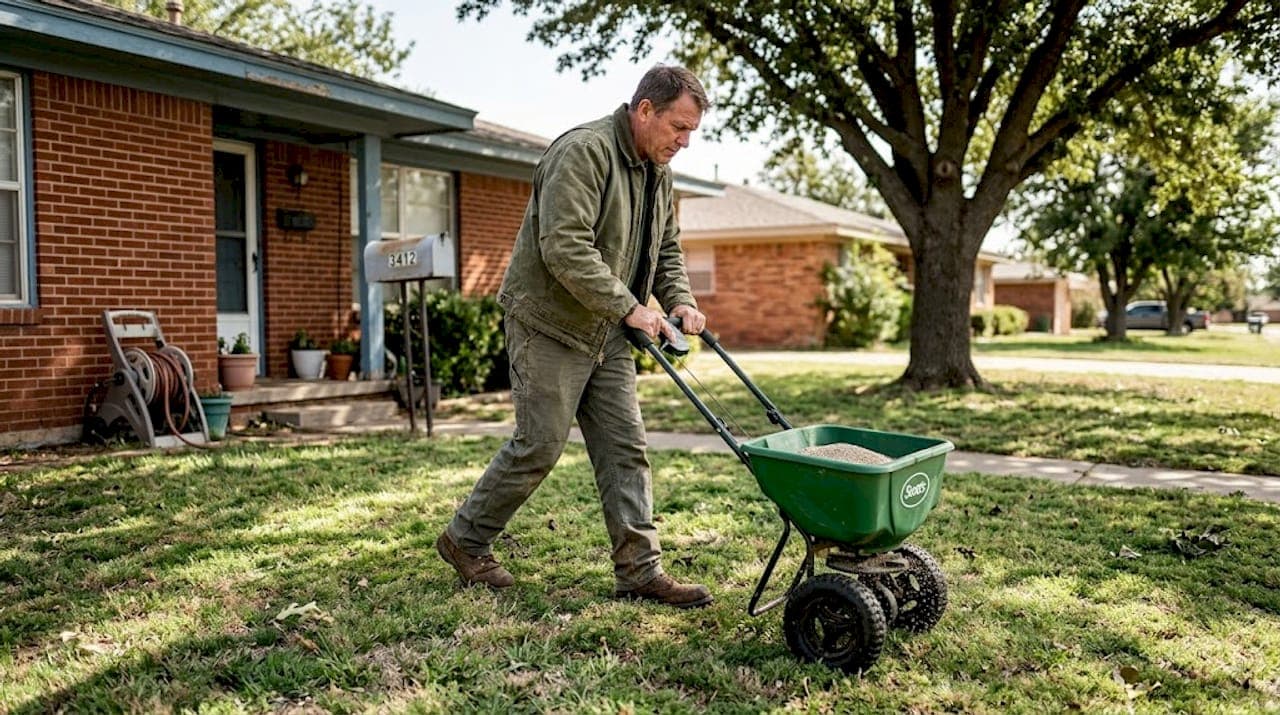
- Fill the spreader on a hard surface. Fill it over a driveway or sidewalk, not over the lawn. Any spilled fertilizer on grass can cause a concentrated burn spot.
- Apply in two passes. Walk in one direction for the first half of your product, then walk perpendicular for the second half. This cross-hatch pattern helps you get even coverage and avoid streaks.
- Overlap edges slightly. Don't leave gaps between passes. A 10 to 15% overlap ensures you won't miss strips along the edges.
- Water the lawn after application. Apply about a quarter to half an inch of water within 24 hours to move the fertilizer into the soil and reduce burn risk. Don't water so heavily that water runs off the lawn.
- Clean the spreader immediately. Rinse it thoroughly after use. Fertilizer residue corrodes metal parts and clogs mechanisms.
"Late-season nitrogen applications can push new growth that's vulnerable to frost damage, which is especially risky in West Texas. Texas A&M research confirms that the nitrogen cutoff for Lubbock lawns is October 1."
Following that cutoff is not just a suggestion. It's the line between protecting your lawn through winter and setting it up for winter kill. For more practical seasonal strategies, the spring lawn care guide covers how to set up your lawn for success from the start of the growing season. You can also find additional fertilizing tips written specifically for local conditions.
Troubleshooting, environmental care, and top mistakes to avoid
After you've completed your application, here's how to keep your yard and the environment safe while troubleshooting common issues.
The most common fertilization mistakes
Most lawn damage from fertilizer comes down to a handful of preventable errors:
- Over-application: Applying too much at once is the leading cause of fertilizer burn. Streaks of yellow or brown turf that appear within a day or two of fertilizing are a red flag.
- Wrong timing: Fertilizing too late in the season, or during a drought without irrigation, sets the lawn up for stress rather than recovery.
- Uneven spread: Skipping the cross-hatch pattern leaves visible stripes of darker and lighter grass for weeks.
- Fertilizing wet grass: Granules stick to wet blades, which increases the risk of burn exactly where you don't want it.
- Ignoring the soil test: Applying phosphorus when your soil already has excess phosphorus doesn't help the lawn. It increases the risk of nutrient runoff into local waterways.
How to fix fertilizer burn
If you spot brown or yellow streaks within a few days of applying, immediately water the area deeply for two to three days in a row. This dilutes the concentrated nutrients and moves them down past the root zone where they can't continue burning. In most cases, the grass will recover within two to three weeks if it wasn't left too long without water.
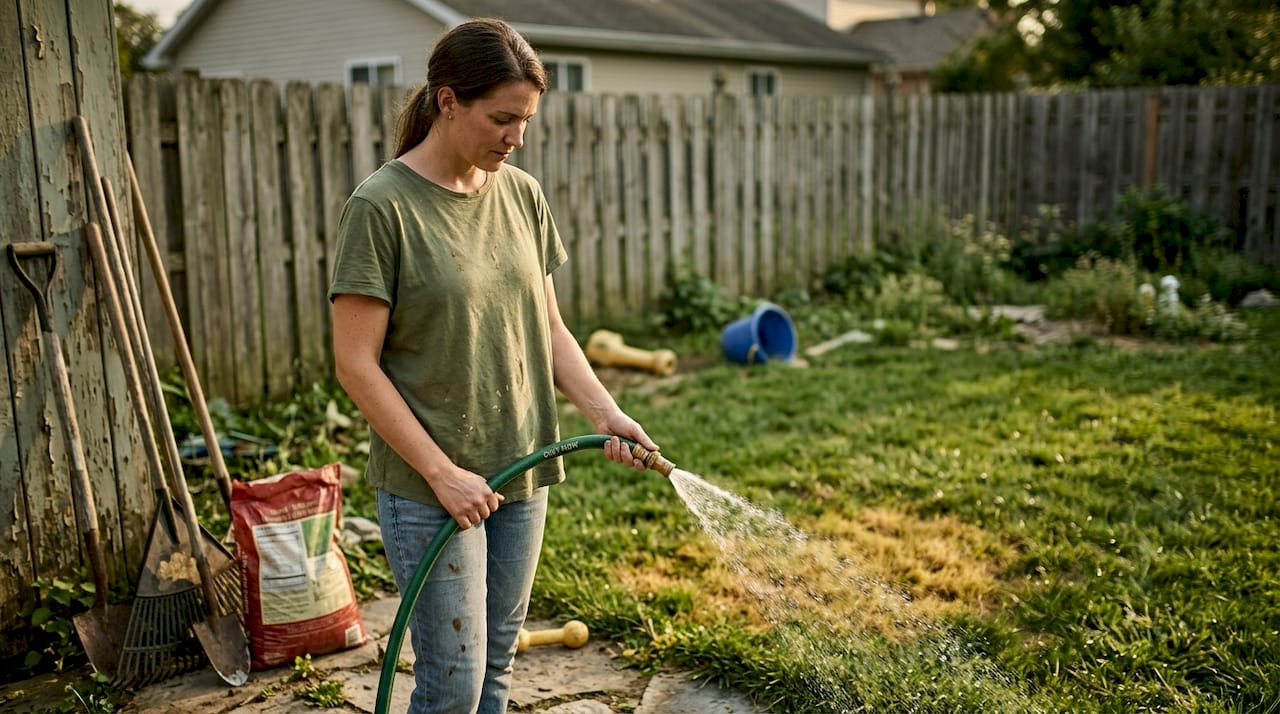
If the burn is severe and the grass blades are completely dead at the crown, you may need to overseed or resod small sections. Prevention is always easier than repair.
Protecting Lubbock's environment
Avoiding over-fertilization and following label rates are the most important actions a homeowner can take to reduce environmental and runoff risks, according to Texas A&M AgriLife Extension.
Lubbock sits in a region where water is precious and storm drains carry runoff directly into playa lakes and the broader watershed. Even a single misapplied bag of fertilizer can contribute excess nitrogen and phosphorus to local water bodies, triggering algae growth that disrupts aquatic ecosystems. Following timing and rate instructions is not just about your lawn. It's about being a responsible neighbor.
For homeowners interested in reducing their chemical footprint while still maintaining a healthy yard, the eco-friendly lawn care guide offers practical alternatives that work in Lubbock's climate.
Lubbock lawns: Why following the science beats shortcuts every time
Here's something most lawn care advice glosses over: the biggest reason Lubbock lawns underperform isn't product quality. It's the approach. We see it constantly. A homeowner buys a bag of fertilizer in March because their neighbor swears by it, throws it down without measuring, skips the soil test, and then wonders why the lawn looks uneven by July.
West Texas soil is not average soil. Lubbock's heavy clay, high pH, and low organic matter content mean your lawn has needs that differ from lawns in Houston, Dallas, or anywhere else in the state. A generic spring application schedule built for East Texas conditions can actually stress a Lubbock bermudagrass lawn more than it helps it. Alkaline soils lock up iron and manganese, creating nutrient deficiencies that look like disease but are actually chemistry problems.
The "one bag fits all" mentality is a product of how fertilizer has been marketed for decades. It's not a reflection of what turf science actually says. Soil testing and split applications aren't overkill. They're the fastest path from a struggling yard to a yard that holds its own through Lubbock's brutal summers and sharp fall transitions.
The good news is that the tools to do this right are more accessible than ever. Texas A&M AgriLife research is publicly available. Local soil labs provide fast results. And once you've built a plan around real data, the results show up fast. Homeowners who follow a test-based approach typically see visible improvement within two growing seasons. That's not a long wait for results that stick year after year.
The lawn care essentials resource is a great companion if you want to connect fertilization to your broader lawn maintenance strategy. Change your process, and your yard will follow.
Need help with your Lubbock lawn? Local experts are ready
If this guide has you feeling confident, great — you're ready to tackle your lawn with a real plan behind you. But if the soil test numbers, spreader math, and seasonal timing feel like a lot to manage on your own, that's completely understandable.

Only Mow is Lubbock's locally operated lawn care team and the official vendor for the City of Lubbock. We work with homeowners across the area to handle everything from seasonal fertilization schedules to full yard restoration. Whether you want expert advice so you can DIY with confidence, or you'd prefer to hand the whole thing off to a professional, we have an option that fits. Visit our Lubbock lawn care services page to get a quote or schedule a consultation. If you're looking to connect with a certified local professional in your specific area, you can also find a landscaper through our network.
Frequently asked questions
What time of year should you fertilize your Lubbock lawn?
Fertilize during active growth from late spring through early fall, with the last nitrogen application no later than October 1 for West Texas lawns per Texas A&M guidelines.
How much fertilizer does a typical Lubbock yard need per year?
The amount depends on your grass type and how intensively you maintain it. Common bermudagrass needs 2 to 5 lbs of nitrogen per 1,000 sq ft annually depending on management level.
Why is a soil test important before fertilizing?
A soil test shows your lawn's actual nutrient levels so you apply only what's needed. Texas warm-season lawns need P and K amounts determined by the test, not by guesswork.
What's the main risk of over-fertilizing a yard?
Over-fertilizing burns grass, wastes money, and pushes excess nutrients into local waterways. Texas A&M emphasizes that following label rates and timing guidelines is essential to reduce runoff and environmental damage.